
faible and failure
Isabelle Mann and I first met at the Moclue Stammtisch – a place where our shared passion for fashion and knitting continues to shine through. As a successful fashion designer, Isabelle founded her own label, Faible and Failure, in 2019 in Hamburg’s Karoviertel, and has since become a well-established figure in the city's fashion scene.
In this interview, Isabelle shares insights into her creative process, the challenges of the fashion industry, and her personal connection to her craft.


© faible and failure/Lisa Knauer
What inspired you to start Faible and Failure?
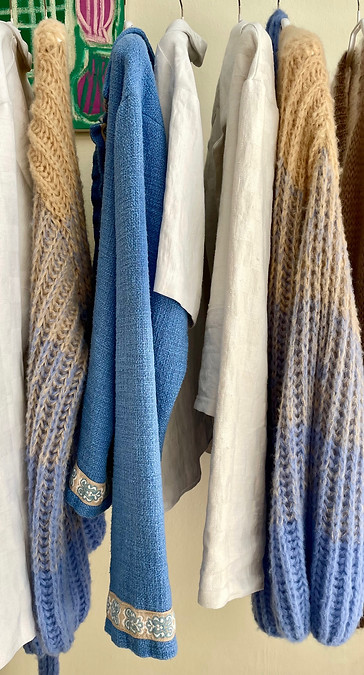
The idea for knitwear came to me in 2018, during my time at the label Black Velvet Circus. My former boss, Tanja Glissmann, introduced me to the world of knit design, and that’s where my passion for it began. I noticed that there were hardly any sustainable knitwear labels on the market, which motivated me to create something of my own. I didn’t want to follow the traditional path of launching full collections – I wanted to focus on a single product. One that is truly sustainable, available in various colors, and made to order.
That’s how I ended up creating hand-knitted sweaters. At first, I just wanted to test the market: How would people respond to the product? What would they think of the yarn I used? It was important to me to work with sustainable yarns. I started with a vegan brushed cotton yarn, which I really liked for its texture and quality. But in the end, cotton is still cotton – it tends to lose its shape. That’s why I eventually switched to a mohair-silk blend that better meets my expectations.
How would you describe the style and philosophy of your label?
My style is eclectic – a mix of various influences. I strive to create timeless designs, which is always a challenge because you’re often influenced by trends and try to reinterpret them. But my goal is to design pieces that are long-lasting and that you won’t get tired of easily.

© faible and failure/Muriel Liebmann
What challenges did you face when founding and building your label?
I approached the whole thing quite naively. One of the biggest challenges was meeting the minimum order quantities for knitting yarns. That’s why I initially bought hand-knitting yarns, as they were available in smaller quantities. Working with the manufacturers I was actually interested in wasn’t possible at first, because their minimum order requirements were simply too high.
Another major challenge was making the shift from “hand-knitted sweaters” to an established fashion label. It wasn’t easy to move away from the DIY image and be seen as a professional brand.
What’s the craziest or most unusual place where you’ve found inspiration for your collections?
Switzerland – the connection to nature, the tranquility you find there. People value craftsmanship in a truly special way. It grounds me and reminds me of what really matters.
In general, traveling is one of my greatest sources of inspiration. I find it especially fascinating to observe people in Japan. They have such a unique aesthetic and, in many ways, seem far ahead of Europeans.

© moclue
Is there a specific goal you want to achieve with Faible and Failure?
My long-term goal is to make Faible and Failure less dependent on me personally and the work I do directly – in other words, to focus more on the B2B sector. While I really enjoy having direct contact with my customers and receiving their feedback, I want to shift my focus toward expansion in the future.
I envision outsourcing more production and growing the business beyond just direct-to-consumer retail. Of course, this is a slow process, since I currently work with small manufacturers who have limited production capacity. It's crucial for me to carefully choose my production partners in order to meet delivery deadlines and manage demand. That’s the only way I can ensure my customers are satisfied.
What kind of projects or collaborations would you like to realize in the future?
I’d love to collaborate with more retailers around the world and develop exclusive collections that reflect local preferences and cultural nuances. For example, in Japan, I offer specific colors that are very popular there but don't perform as well here. I find these regional differences incredibly interesting.
A collaboration with German retailers – such as the Murkudis store in Berlin – would also be a big goal for me.
What does a typical day in your life look like?
I've been trying to establish a consistent routine for the past five years—without success (laughs). But honestly, that’s probably a good thing, because my days are very diverse and depend heavily on the projects I'm working on.
I usually start my day around 11:00 a.m. by checking and replying to emails, and then I dive into the tasks and projects scheduled for the week. My workday typically ends around 7:00 p.m. when I close the shop.
What has been the biggest challenge in your career, and how did you overcome it?
The COVID pandemic was certainly one of the biggest challenges, although looking back, I think the timing was almost more manageable than it would be today since I was still in the early stages of my career.
In addition to working on my label, I took on side jobs to support myself—something I wouldn’t do now, as my brand has evolved significantly since then.
Another big challenge has been time management. When I received my first order from Japan, I ended up having to dye all the products myself. The yarn was extremely delicate—a bouclé silk blend—so I had to knit the sweaters first and then hand-dye them.
I worked day and night back then, which really pushed me to my limits. I definitely want to avoid situations like that in the future.
One of the hardest things for me is setting boundaries and knowing when enough is enough. Planning for mistakes and unforeseen issues is also essential—like when you're missing 10 grams of yarn to finish a sweater because the supplier delivered too little.
These kinds of everyday challenges are a regular part of my work.
© moclue
How does Hamburg influence your work and your collections?
I ended up in Hamburg more by chance—it was never part of my plan or a lifelong dream to live here.
Still, Hamburg has had a strong influence on my work and my collections. In the beginning, I was very focused on the local clientele, which is often quite different from me. Hamburg is very traditional and places a high value on quality.
I really appreciate these traits, as they highlight the craftsmanship behind my work.
As someone from Saarland, I enjoy pushing boundaries and constantly ask myself: How can I be typically different?

© moclue
In your opinion, what makes Hamburg’s fashion scene unique compared to other cities?
Hamburg’s fashion scene is small—but that’s also what makes it special (laughs).
There’s a close-knit, sustainable community where people know and support each other.
It’s not just about fashion, but also about shared events, and a lot of collaborations emerge—for example, with photographers.
In Berlin, I didn’t experience that kind of network, but here, many people approached me directly.
That mutual support was a wonderful experience. Berlin is much bigger and more saturated, which made it harder for me.
How have you built your network in the fashion industry over the course of your career?
Having my own store really helped me connect.
A lot of people simply walked in and started a conversation. I was also contacted by many through Instagram.
Even though I’m more of an introvert, that openness helped me build a network.
By now, I know who I can rely on, and I truly value the strength of that kind of network.
I’ve also made great contacts through events and the Fashion Council Germany—and I hope to meet even more inspiring people in the future.
If you could give your younger self one piece of advice, what would it be?
“Don’t do it!” (laughs).
You really need enormous perseverance. It takes years before people take you seriously and your product actually catches on.
I would advise anyone to start as small as possible. Focus on one single product that you can market well and continue to develop, instead of getting lost in a full collection and high costs. It often takes a year before a new design is even noticed and becomes successful.
What do you do to relax and recharge?
That’s a big challenge for me. Incorporating breaks into my daily routine is difficult.
Living and working in the same place is both a blessing and a curse. I don’t have a commute, but that also means work is always present.
I can only truly relax when I go on vacation, leave Hamburg, and don’t take any knitting projects with me.
It’s an ongoing process to find the right balance.
How would you describe yourself in three words?
Ambitious – meaning it takes a lot for me to give up.
Introverted and freedom-loving – because the freedom that my work gives me is very important to me.
Who have been your biggest role models, and how have they influenced you?
Vivienne Westwood has been a major role model - especially her multidisciplinary approach and her work as an educator.
I’m also inspired by the label Bode New York by Emily Adams Bode.
They work with vintage textiles and use nostalgic elements to reflect on family history and heritage in a very unique way.
That idea of engaging with one’s own roots fascinates me as well.

© moclue
Which values and beliefs are especially important to you in life, and how are they reflected in your work?
Loyalty, tradition, and my heritage are core values for me.
I try to carry these forward in my work by constantly developing and refining my expertise.
In my family, women have passed down their craft skills from generation to generation, and I see it as my responsibility to preserve and share this knowledge.
This also shapes the way I build my network, where mutual support plays a key role.
Is there a country or culture that fascinates and inspires you in particular?
I absolutely love traveling to Asia, especially Japan.
The textile and craft culture there—as well as the respectful way people treat one another—deeply impresses me.
Japan is the country of masters. They take their craftsmanship to the highest level of perfection, and I admire that they haven’t forgotten their roots and traditions despite their modern lifestyle.
What is your favorite place in Hamburg and why?
Planten un Blomen. I love gardens in general, probably because I grew up in a village with a lot of open space.
It's wonderful to have such expansive green oases right here in the city.


© faible and failure/ Teresa Enhiak Nanni
What’s the best advice you’ve ever received, and from whom?
The best advice was: “Just do it!”
To have the courage to take action, talk to people, and simply ask.
I often hesitate because I’m afraid of being rejected.
But in the end, you have nothing to lose.
My husband constantly encourages me to be brave and just give it a try.
If you could have one superpower, what would it be and how would you use it?
I’d love to be able to teleport.
Then I could instantly travel from Hamburg to Japan or New York and soak up the inspiring differences between these cities and cultures.
I love drawing inspiration from different environments and experiencing new perspectives.
What’s on your mind right now?
I often think about how to achieve sustainable growth for my label without losing the identity of Faible and Failure.
I want the label to become less dependent on me personally -but at the same time, the products are a part of who I am.